
St. Louis County Inmate Population
St. Louis County inmate population records are managed by the largest county by land area in all of Minnesota. The Sheriff's Office, led by Sheriff Gordon Ramsay, oversees a staff of about 290 people across eight divisions that cover everything from patrol to jail operations. Inmate population data here is public under state law, and the county provides access through the Sheriff's Office and state-level databases. Whether you need to check on a current inmate or track someone who has moved into the state prison system, there are clear paths to get that information. Duluth serves as the county seat and main hub for law enforcement operations.
St. Louis County Overview
St. Louis County Sheriff's Office
The St. Louis County Sheriff's Office is one of the most extensive law enforcement agencies in northern Minnesota. Sheriff Gordon Ramsay leads about 290 staff members across eight divisions. The office's mission is partnership with the community for enhanced public safety through innovation and dedicated people. That mission shapes how they handle inmate population records and public access to data.
The eight divisions are Sheriff, Boat and Water, Homeland Security and Emergency Management, Rescue Squad, Law Enforcement Services, Emergency Communications, Radio Maintenance, and Jail. The Sheriff Agency itself has five subdivisions that handle specific duties. Administration covers office management and budgets. Patrol handles daily law enforcement across the county's vast territory. Investigations works on criminal cases. Civil and Warrants processes court papers and arrest warrants. Court Security protects the courtrooms.
Because St. Louis County is so large geographically, the Sheriff's Office covers a territory that stretches from Duluth up into the Iron Range and beyond. Getting inmate population data may involve contacting different offices depending on where in the county the arrest happened. The jail in Duluth is the main detention facility.
| Office | St. Louis County Sheriff's Office |
|---|---|
| Sheriff | Gordon Ramsay |
| Website | stlouiscountymn.gov/sheriff |
| Staff | Approximately 290 |
| Divisions | 8 total |
How to Search Inmate Population
There are several methods for looking up St. Louis County inmate population records. The most direct way is to contact the jail division of the Sheriff's Office. Give them a name and date of birth, and staff can tell you if someone is currently in custody. This is the fastest option for current status checks.
For inmates who have moved into the state system, the Minnesota DOC Inmate Locator shows people committed to state prison. If a St. Louis County case resulted in a prison sentence, the person shows up in this database. You can search by name or DOC ID number. The DOC Search Portal adds fugitive search tools and victim notification options.
Court records provide yet another way to track cases. The Minnesota Judicial Branch publishes case information for St. Louis County courts. Sentencing details, probation terms, and case outcomes are all available. These records connect to inmate population data by showing what happened after the initial arrest and booking.
Note: Given the county's large geographic area, arrests in remote parts of St. Louis County may take longer to process and appear in databases.
The St. Louis County Sheriff's website provides information about all eight divisions and jail operations.
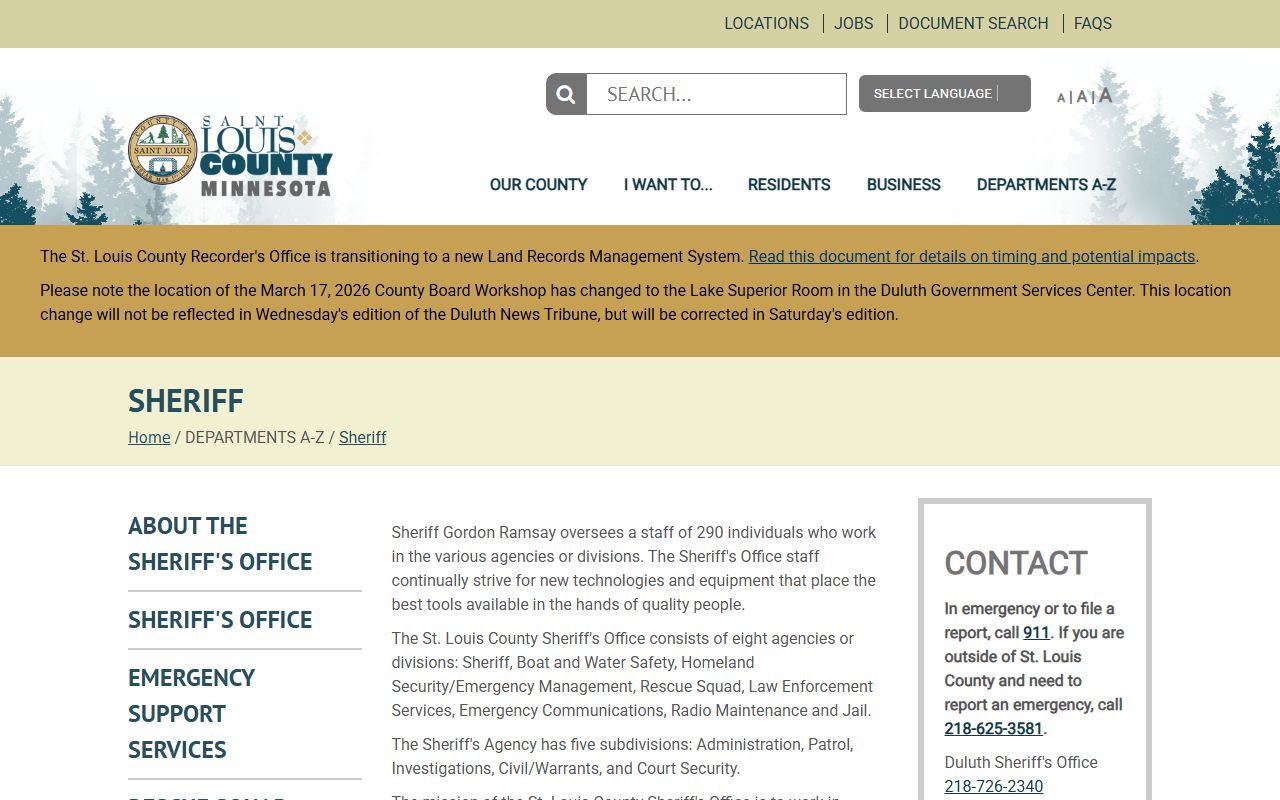
Sheriff Gordon Ramsay leads about 290 staff across the largest county by area in Minnesota, with operations based out of Duluth.
Public Data and Inmate Records
St. Louis County follows the Minnesota Government Data Practices Act for all inmate record releases. Arrest data is public. That means the inmate's name, charges, arrest time and place, the arresting officer, and current location are all available to anyone who asks. This applies to every booking that goes through the St. Louis County jail.
Some types of inmate data remain private. Medical and psychological records cannot be shared with the public under any circumstances. Financial details about people in custody are also restricted. Under Minn. Stat. 13.85, corrections and detention data gets classified based on whether its release could create security risks or harm the inmate. Data that has been presented in open court becomes public to the extent it appears in court filings. Victims have specific rights to certain data even when it would otherwise stay classified.
The Bureau of Criminal Apprehension maintains criminal history records statewide. St. Louis County arrest data feeds into this system. BCA background checks are available but may require fingerprints and a processing fee.
Jail Operations and State Law
The St. Louis County jail processes bookings following standard procedures. Fingerprints, photos, personal information, and all charges get logged when someone is brought in. Staff run warrant checks and enter the data into the inmate population system. Because of the county's size, arrests can happen far from Duluth, and transport to the main jail adds time to the process.
State law sets clear rules for how jails run. Under Minn. Stat. 641.14, inmates must be separated by gender, and juveniles are housed apart from adults. Meals, medical care, and communication access are required. The jail reports inmate population data to the courts weekly and to the BCA as Minn. Stat. 641.05 requires. Minnesota's ban on private prisons under Minn. Stat. 641.015 means St. Louis County runs its own jail entirely.
Discharge planning under Minn. Stat. 641.155 is part of the release process. Staff connect inmates with community resources before they leave. In a county as large as St. Louis, those resources might be far from where the person actually lives, which can make the transition harder. The jail still has to make the effort and document what services were offered.
State Corrections Resources
Under Minn. Stat. Chapter 243, the Commissioner of Corrections oversees all state prisons in Minnesota. When someone from St. Louis County gets sentenced to prison, they transfer from the county jail to a state facility. Both county and state systems maintain records of the transfer, so there should not be gaps in tracking the inmate's location.
The DOC runs a victim notification service that covers state prison inmates. If a victim in a St. Louis County case wants to know when the offender is released or transferred, they can register for automatic alerts. This service is free and covers all state correctional facilities.
Cities in St. Louis County
St. Louis County covers a vast area of northeastern Minnesota. Duluth is the largest city and county seat.
Other communities in St. Louis County include Hibbing, Virginia, and Eveleth. All inmate population records for these areas are held by the St. Louis County Sheriff's Office.
Nearby Counties
St. Louis County borders several other northeastern Minnesota counties. Inmate transfers between facilities can happen based on capacity or specialized needs.